The Young Farming Champions (YFC) are identified youth ambassadors and future influencers working within the agriculture sector.
Australia is the hottest, driest continent with some of the poorest soils on the planet, yet our farmers supply safe, affordable, nutritious food for 60 million people across the globe.
To do this Australian agriculture requires talented people. The program selects emerging young people and then develops their problem-solving, their creativity, their communication and teamwork skills.
The YFC has a two year program Cultivate – Growing Young Leaders designed and run to support young people involved in a broad range of agricultural careers – from farming to consulting to marketing – to be skilled, confident and comfortable to share their stories. This program is now open for expressions of interest.
The program supports selected young people through skills training, mentoring, coaching, networking and by providing them with opportunities to tell their story.
Running since 2009, more than 100 young leaders have been trained in the program.
All the information you need to know about the program can be found by clicking here.
AWI has announced the launch of the Woolmark Learning Centre, The Woolmark Company’s digital platform for all wool learning.
This platform is an exciting development and will facilitate the education of all stakeholders in the global wool industry – from woolgrowers to textile engineers, fashion design students, trade, designers, brands and retailers.
Education is a key strategic pillar within our business and the Woolmark Learning Centre will facilitate industry access to knowledge within the global wool supply chain. I’d like to thank the industry experts who have contributed their amazing knowledge and expertise to the creation of the industry leading course content.
Below you will find full details on how to access and utilise the coursework.
The digital education platform has been developed by experts and leaders within the textile industry to enable knowledge transfer across the global supply chain.
Free to all users, the platform will focus on the following key content pillars:
 |
Fashion and Design |
 |
Science and Technology |
 |
Sustainability |
 |
Innovation |
AWI recommends you begin with the Fundamentals of Wool course which will give you a sound foundation in understanding the wool fibre from farm to fashion. The science and technology program will also serve to extend your knowledge with postgraduate level coursework.
On completion of the course, users will be awarded a Credly badge which we encourage to be link to digital professional portfolios.
Faciliators have extended access to the platform with teaching notes and printable resources available to support face-to-face teaching.
The Woolmark Learning Centre will continually evolve. Once registered, users will be updated when new coursework is available.
For enquires about the Woolmark Learning Centre and to learn how you can integrate the platform into your institute, business or classroom, please contact the Woolmark Learning Centre project manager Penelope Kendall: penelope.kendall@wool.com
You can register here.
AWI releases Beyond the bale – December 2019 in Flip Book format.
In this issue AWI has partnered with the most popular sheep in the world, Shaun the Sheep, during the global roll-out of his new movie ‘Farmageddon’, in a series of initiatives to educate the public about the benefits of wool.
The initiatives include a unique short animation film titled ‘Super Natural Wool’ that features Shaun, plus Shaun-inspired educational materials, games and activity sheets hosted on a campaign website
View the complete December edition
Call for Abstracts
Are you an Animal Scientist working with production animals? Zoology? Wildlife? Marine Animals? Do you work in food production?
Or with social and economic issues that interface with the management of animal systems?
The Animal Production 2020 team will be closing the call for abstracts on 30th November.
Submit your abstract now at
www.animalscienceconference.com.au
The #AAAS2020 Editorial Committee welcomes abstracts from researchers working in any field of Animal Science.
- Abstracts will be assessed against the conference theme ‘The new face of Animal Science in Australia’
- The Editorial Committee will invite a limited number of authors to prepare a full six-page paper for a Special Edition of Animal Production Science.
Note:
Authors of abstracts who are not invited to submit full papers will have the option to submit one page papers through the second call for submissions for publication in Animal Production in Australia.
The Australian Association of Animal Sciences (AAAS) is the ‘new face’ of Animal Science in Australia. AAAS builds on the strengths of its predecessor, the Australian Society of Animal Sciences (ASAP), which was founded over 60 years ago to promote animal science in Australia
The Royal Agricultural Society of NSW Foundation (RASF) is calling for applications for VET Scholarships. VET Scholarships aim to support students in NSW who demonstrate a passion for rural life and commitment for any career that will ensure the future success of rural and regional NSW.
There is no limit on the types of courses that qualify and you could be studying a range of courses including Wool Classing, Food Science, Boilermaking, Farming and Nursing, through TAFE and other registered providers.
Scholarships of $6,000 for full-time study and $3,000 for part-time study are available.
Applications close Sunday 19 January 2020.
Contacts:
Cecilia Logan
Manager RAS Foundation
02 9704 1226
Emma Duffy
Manager Scholarships & Grants
02 9704 1234
Each year AWET distributes grants to selected Fashion Design students, to facilitate purchase of wool-rich fabric for their final year design projects. The students are selected by the Fashion School. University of Technology Sydney is one of the participating schools. This year’s students were Hazel Dong, Ying Huang, Tegan Kearney, Domenic Roylance. The students presented their collections at UTS on Thursday 14th November, 2019
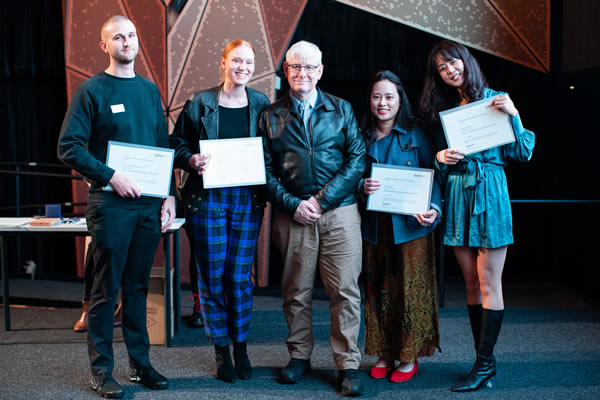
From L to R: Domenic Roylance, Tegan Kearney, Peter Sommerville (Secretary of AWET), Ying Huang, Hazel Dong.
The Trust supports the VET sector via a number of scholarships, valued at $3,000 each, being made available per year to students attending institutions in this sector.
Applications for these scholarships are made on behalf of the student(s) by the institution at which the student is enrolled.
One of the Colleges utilising these scholarships is the West Australia College of Agriculture – Cunderdin
This year the College selected 3 students – Courtney Hall, Tameka Baker and Hayden Fiegert. Each was awarded a scholarship. The scholarships were awarded to the students by the Principal of the College, Sally Panizza, on behalf of AWET at the College’s Valedictory Ceremony on Friday 15th November 2019.
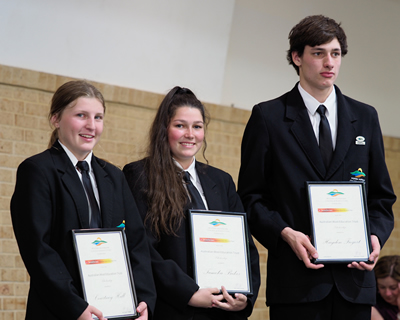
From L to R: Courtney Hall, Tameka Baker, Hayden Fiegert.
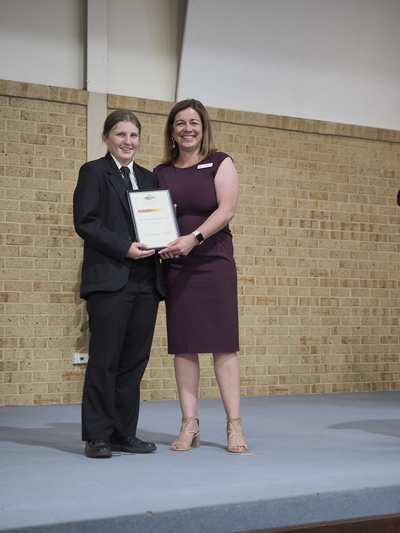
Courtney Hall and Sally Panizza.
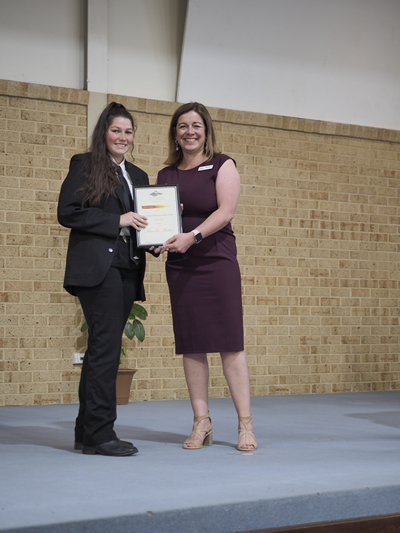
Tameka Baker and Sally Panizza.
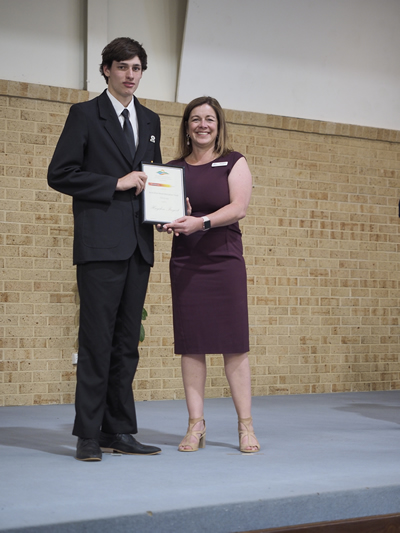
Hayden Fiegert and Sally Panizza.
Vision
Rural educational excellence through innovation, passion and collaboration.
Mission
- Foster a safe and healthy residential and learning environment in which the whole College promotes the DOE values of Learning, Excellence, Equity, Care, Integrity and Respect.
- Enable all students to develop the knowledge, skills and confidence to achieve their individual potential and contribute to society.
- Provide opportunities for students to develop knowledge, skills and values within the context of rural industries.
- Ensure all students achieve nationally recognised vocational qualifications and Secondary Graduation (WA Certificate of Education).
When the Wool Technology journal was first published in 1954 by the University of New South Wales it was a unique vehicle for communicating technical information to sheep and wool industry participants. The journal also provided an advertising vehicle for Merino studbreeders and industry service companies in its earlier years.
There have only been three editors during its life. Professors Pat McMahon and Euan Roberts edited the journal from 1954 until 1976. Professor Roberts remained editor until 1992 when Prof. Cottle became editor. The journal was published from UNSW, WRONZ and then UNE before it developed into the Internatonal Journal for Sheep and Wool Science.
Many journal papers were generated from the annual Wool Schools held at the School of Wool and Pastoral Sciences at UNSW. School staff and graduates have been responsible for much of the research in the sheep and wool industry with many School graduates taking up research and extension positions in CSIRO, State Departments, Universities etc.
When the journal(s) ceased publication in 2010 the then Editor, Professor David Cottle created an on-line archive using Open Journal Systems (OJS) as a platform. Subsequent to his retirement the management of this archive was transferred to the Australian Wool Education Trust.
The Trust has overseen an updating of the OJS’s software and relocated the archive to an OJS server to ensure its longevity going forward.
Consistent with its approach to supporting wool and sheep education the Trust has made access to the archive open source to registered users i.e. available at no fee.
To access the archive use this link Sheep and Wool Journal
OJS is a publishing system providing a submission, review, editing and publishing process that meets the normal requirements for science based publications. However, at this point submissions for publication are not being accepted.
Media Release
The Federation of Australian Wool Organisations (FAWO) is a peak wool industry body whose Membership comprises AWEX, AWH, AWI, AWTA, and national Associations representing wool growers, brokers, exporters and processors. It represents Australia at the International Wool Textile Organisation (IWTO) and addresses wool industry issues of cross sector importance both locally and internationally. These include issues such as biosecurity matters.
FAWO achieved two major milestones at its Annual General Meeting last week.
Firstly, it passed a number of changes to its Constitution that are designed to encourage wider participation in its activities. These start with a change in name to Wool Industries Australia (WIA) and include other changes of a structural nature.
Secondly, it celebrated these changes with the organisation of a Forum in which its Member organisations were asked to speak about the impact of the drought on their sector of the industry. Over 70 people from growers to retail; and from the service sectors participated. Discussion was wide ranging and free flowing.
The commercial issues of having 12.1% less wool produced in 2018/19 and a further 5% less expected in 2019/20 are very apparent, as is the need for wool growers to purchase grain and hay to feed their sheep.
But, less apparent are the impacts of social and welfare issues on-farm and in rural towns, where there are less funds available for spending and for employment. Brokers referred to the personal impacts on their staff arising from their direct interaction with wool growers who are living with the drought. They also referred to the loss of expertise from the industry.
Also less apparent are the greater difficulties that wool exporters may have in meeting customers’ contract specifications, particularly for wool types that were not in large supply, even before the drought. This is given greater emphasis by the increasing demand from Australia’s customers for wools that meet traceability, sustainability and animal welfare requirements.
The importance of responding to this type of challenge was highlighted in a presentation to the Forum by Country Road CEO, Scott Fyfe. Country Road’s vision includes a “Responsible Wool Strategy”, which states:
“All Country Road’s pure wool and wool rich products will be fully traceable and certified by a credible third–party to ensure high animal welfare standards and sustainable farming practices by Winter 2025.”
Leading Italian processor, Giovanni Schneider described these issues as becoming more important than wool quality issues when speaking at the recent IWTO Congress in Venice.
The full presentations can be found at https://www.fawo.org.au/publications/
| David Michell | Bianca Heaney |
| Chairman | Secretary |
| 08 8209 4400 | 03 9311 0103 |
The Sheep CRC has finally concluded its objectives and as of the 30th June 2019 it will be wound up. However, the accomplishments of the CRC will continue to yield benefits to the sheep and wool industry.
Read the final Sheep CRC Newsletter